
The AI Trust Gap at Work: Why Employees Don’t Trust AI (and How Leaders Can Fix It)
How to build trust with employees during AI adoption
AI TRANSFORMATIONAI LEADERSHIP
Joe Mirabella
4/28/20263 min read
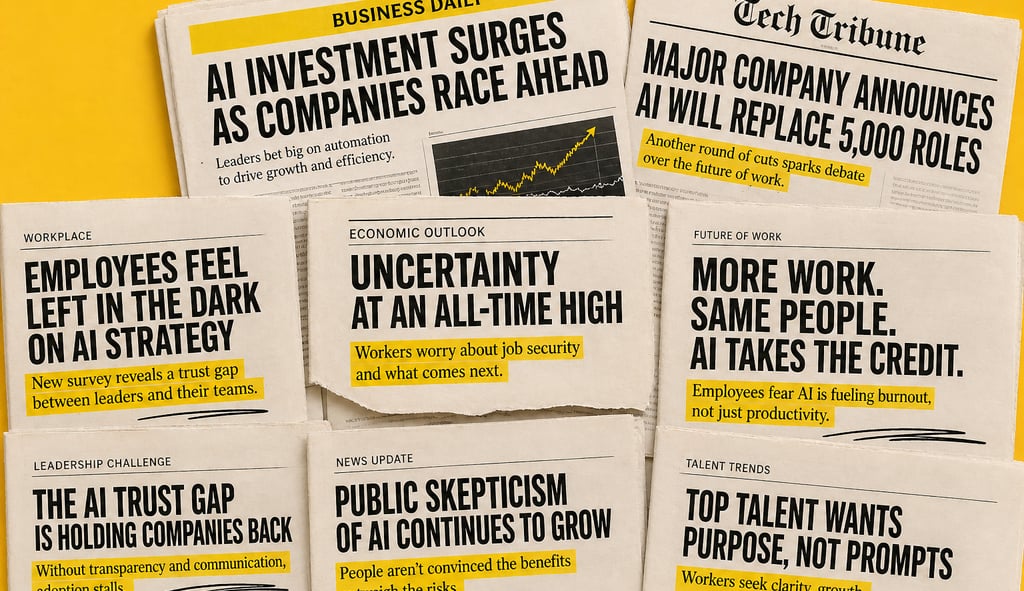
AI is moving fast inside organizations. Leadership teams are investing, experimenting, and in many cases, pushing forward with urgency.
But employees? They’re not always coming along for the ride.
A growing body of research—from sources like PwC, Axios, Public Citizen, The National Bureau of Economic Research, and more—points to a widening gap between how leaders and employees perceive AI. Leaders tend to see opportunity. Employees often see risk.
And that gap isn’t just philosophical—it’s operational. It’s the difference between successful AI adoption and quiet resistance.
The Core Problem: Trust, Not Technology
One of the most important insights comes from Harvard Business Review:
Employees don’t just need to trust AI. They need to trust the people asking them to use it.
If leadership credibility is shaky—or if communication is vague—AI becomes a proxy for deeper concerns:
“What does this mean for my job?”
“Are we being asked to do more with less?”
“Is this about innovation… or cost-cutting?”
Meanwhile, leadership teams are often influenced by a different narrative—one shaped by market pressure, investor expectations, and headlines about transformation. As noted in The Hill, executives frequently overestimate how quickly AI can (and should) be adopted.
The result: misalignment from day one.
Why the Gap Exists
Research from IPSOS highlights a key tension:
Leaders view AI as a strategic advantage
Employees view AI through a personal lens—impact on workload, identity, and job security. 72% want the government to step in to protect jobs.
Add to that broader skepticism. Reports like those from Public Citizen show that public trust in AI remains fragile, especially as big tech continues to promote its benefits without always addressing real-world consequences.
In other words: employees aren’t irrational. They’re responding to what they see.
What Smart Organizations Do Differently
Closing the AI trust gap isn’t about better tools. It’s about better leadership.
Here’s what actually works:
1. Share a Clear—and Honest—AI Roadmap
Vague messaging kills trust.
Instead of “we’re exploring AI,” leaders should clearly articulate:
What AI will be used for
What it won’t be used for
What success looks like
How roles may evolve (not just “improve”)
Honesty matters more than polish. If change is coming, say so.
2. Invite Feedback Before Launch
Too many organizations roll out AI initiatives and ask for feedback after the fact. By then, employees have already formed opinions—and often, resistance.
Instead:
Hold listening sessions early
Ask directly: “What concerns you about this?”
Treat feedback as strategy input, not optics
This isn’t just culture-building. It’s risk management.
3. Be Willing to Adjust
If employee feedback doesn’t change anything, people notice.
Trust builds when organizations:
Pause initiatives that aren’t working
Adjust timelines based on team readiness
Redesign workflows based on real usage
AI adoption should be iterative—not dictated.
4. Measure What Actually Matters
Leaders often default to measuring output: speed, volume, efficiency. Employees care about something else:
Is my job more manageable?
Is this making my work better—or just faster?
Am I gaining skills or losing relevance?
Will the technology replace me?
Track both sides:
Productivity gains
Employee experience and sentiment
If one improves while the other declines, you don’t have success—you have a problem.
5. Keep the Conversation Open
AI isn’t a one-time rollout. It’s a continuous shift.
Organizations that succeed:
Create ongoing forums for discussion
Normalize uncertainty (“we’re learning too”)
Share updates transparently—even when things don’t go as planned
Silence creates assumptions. Communication builds alignment.
6. Acknowledge the Fear—Directly
This is the part many leaders skip.
The fear of job displacement is real—and increasingly rational given recent headlines across industries.
Avoiding the topic doesn’t reduce anxiety. It amplifies it.
Strong leaders:
Acknowledge the uncertainty
Clarify where human roles remain essential
Invest in re-skilling and growth—not just automation
People don’t need guarantees. They need honesty.
The Bottom Line
The AI trust gap isn’t a technology problem. It’s a leadership problem.
Organizations that treat AI as a purely technical implementation will struggle.
Organizations that treat it as a human transition will lead.
At Suns Out Agency, we see this firsthand: the companies making real progress with AI aren’t the ones moving the fastest—they’re the ones bringing their people with them.
Because in the end, AI doesn’t transform organizations.
People do.
Who we are
Suns Out Agency is a Seattle-based AI consulting agency serving clients everywhere.
We blend traditional services — executive communications, content strategy, and digital marketing — with forward-looking AI solutions like workflow automation, custom GPT development, and team training.
Our mission is simple: make your business clearer, stronger, and more effective. Reach out today to get started.
Let'L
© 2026 Suns Out LLC All rights reserved.
Social
Your future in the best light.
Phone
Legal
Our sister brands